
Optimizing Operations: An AI-Driven Framework for T&M and OAC Reporting
In the current construction landscape, firms are data-rich but insight-poor. The proliferation of digital tools has generated an unprecedented volume of project data, yet much of its potential remains locked in disconnected silos. The next phase of digital transformation is moving beyond simple digitization toward intelligent automation, utilizing AI to transform this data into a strategic asset. This evolution is critical for optimizing two of the most historically inefficient and high-risk areas of operations: the Time & Material (T&M) workflow and the Owner-Architect-Contractor (OAC) reporting process.
To gain a competitive advantage, firms must adopt a structured, data-first approach. This article unfolds a framework of best practices for General Contractors (GCs) and Trade Contractors to leverage modern platforms and AI-driven insights, transforming these operational challenges into opportunities for enhanced efficiency and predictability.
The Foundation: Digitizing T&M Workflows for Data Integrity
The traditional, paper-based Time & Materials (T&M) process is a significant source of project risk, leading to disputes, revenue leakage, and delayed payments. The core problem is not just the inefficiency of paper, but the lack of structured, reliable data for analysis and verification. The foundational step toward optimization is to digitize and centralize the entire T&M lifecycle.
Modern construction management platforms are designed to address this challenge by offering a unified system for T&M management. A key capability is the ability to create T&M tickets from either a mobile app in the field or a web browser in the office. This flexibility ensures that all out-of-scope work is captured in a standardized digital format the moment it is identified.
These systems enhance data integrity by automating calculations and integrating evidence to ensure accuracy. Labor costs are calculated automatically from digital timesheets linked to the specific T&M task code, eliminating the need for guesswork. Material and equipment costs are substantiated by allowing field personnel to scan receipts directly into the ticket. Every step, from creation to approval, is captured with digital signatures and timestamps, culminating in a signed PDF that serves as an indisputable digital record.
While this workflow provides immediate operational benefits, its strategic value is in creating a clean, structured dataset. This data is the essential fuel for future AI-driven analysis, enabling capabilities like predictive cost modeling for change orders and anomaly detection for T&M ticket frequency across projects.
Evolving OAC Reporting from Historical Record to Predictive Tool
The traditional OAC report is a high-effort, low-value artifact. Its creation is a manually intensive process of compiling data from disparate systems, resulting in a report that is outdated upon delivery. This data latency means OAC meetings are often spent reviewing historical performance rather than making informed, forward-looking decisions.
The evolution of OAC reporting requires a shift to integrated platforms where data flows in real-time from its source to the report. This creates a single source of truth for all stakeholders. Here’s how a modern approach transforms the process:
- Automated Data Compilation: Instead of PMs spending days pulling data from schedules, budget spreadsheets, and RFI logs, an integrated system compiles this information automatically. This eliminates the "data-handling tax" and frees up project managers to focus on analysis rather than administration.
- Real-Time, Not Historical, Insights: The report reflects the project's status as of this morning, not last week. Decisions are based on live data flowing directly from the field, ensuring that conversations in the OAC meeting are relevant and actionable.
- Customizable, Professional Templates: Modern platforms include report designers that allow companies to create their own professional PDF templates. This ensures that the information presented is not only accurate but also tailored to the specific needs and branding of the project stakeholders, enhancing clarity and professionalism.
- AI-Powered Summaries: The next frontier is the application of AI to not only compile but also interpret this data. The emerging best practice is to utilize embedded AI that can automatically generate an executive summary for reports, highlighting the most critical risks, schedule deviations, and budget variances. This capability translates complex data into clear, high-level insights.
- Beyond the Report – Live Dashboards: For owners who want even more immediate insight, a live Milestone View dashboard provides a more intuitive and powerful alternative to a static report. It provides a high-level summary of progress against key dates and completion percentages, enabling owners to check the project's status on demand, directly from their phone or tablet.
.webp)
AI-Powered Frameworks for Modern Construction Stakeholders
Adopting an AI strategy is a role-specific journey. The value of artificial intelligence is realized when it is applied to solve the unique challenges faced by each stakeholder. The following frameworks offer a practical, multi-step approach for Project Owners, Site Superintendents, and Safety Directors to leverage foundational AI for immediate and future operational benefits.
AI Framework for Project Owners
Goal: Achieve complete project transparency and proactive risk management to maximize ROI.
.webp)
- Step 1: Leverage AI for Document Assurance. Ensure all decisions are based on the correct information by utilizing an AI that processes all plan sheets upon upload. This foundational AI automatically extracts and verifies critical metadata, including the final approval date. This provides owners with the assurance that the progress they are viewing corresponds to the most current, approved version of the plans, mitigating the significant risk of building from outdated drawings.
- Step 2: Demand AI-Driven Executive Summaries. Transition away from dense, manually created reports. The emerging best practice is to utilize platforms with embedded AI that can analyze real-time project data and generate concise executive summaries for OAC reports. This capability translates complex schedule and budget data into clear, high-level insights, allowing owners to grasp the project's status in minutes, not hours.
- Step 3: Implement AI for Predictive Milestone Monitoring. Shift from reviewing past performance to anticipating future outcomes. Utilize a system that allows AI to track the progress of all tasks associated with a specific milestone. By monitoring the real-time performance of these dependencies, the AI can generate a predictive completion percentage and flag milestones that are at risk of delay, giving you a crucial early warning.
- Step 4: Utilize AI for Financial Anomaly Detection. Gain a deeper level of financial oversight. A future application of AI will be to analyze cost data across your entire portfolio, learning the typical cost patterns for different project types and phases. The system will then be able to flag anomalous spending in real-time on your current project, alerting you to potential budget overruns or irregularities long before the end-of-month report.
- Step 5: Employ AI for Automated Visual Verification. Verify progress without constant site visits. As AI capabilities evolve, they will be used to analyze the stream of daily progress photos and videos from the jobsite. The AI will learn to recognize key construction phases and can be trained to automatically verify reported progress (e.g., confirming that rebar is laid before a concrete pour is marked complete), providing an unbiased layer of verification.

AI Framework for Site Superintendents & Foremen
Goal: Reduce administrative workload, enhance on-site decision-making, and streamline communication with the office.
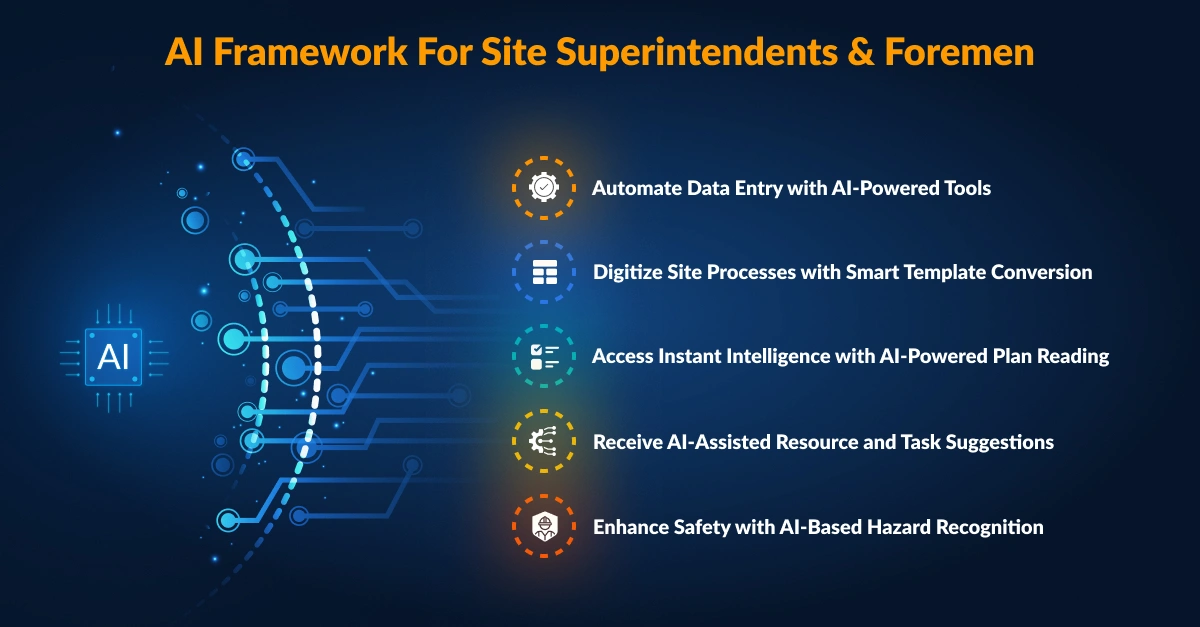
- Step 1: Automate Data Entry with AI-Powered Tools. Drastically reduce time spent on end-of-day reporting. Use voice-to-text dictation for daily logs and notes within your Field Journal app. This foundational AI feature eliminates the need for manual typing, enabling you to capture detailed notes while walking the site and resulting in more accurate and timely reports with minimal effort.
- Step 2: Digitize Site Processes with Smart Template Conversion. Instantly convert any paper-based form or checklist into a usable digital template. Simply upload a photo or PDF of your existing form, and let the AI process the document and convert it into an interactive digital checklist. This allows you to rapidly digitize all your unique site processes from quality control to pre-pour inspections without any manual setup.
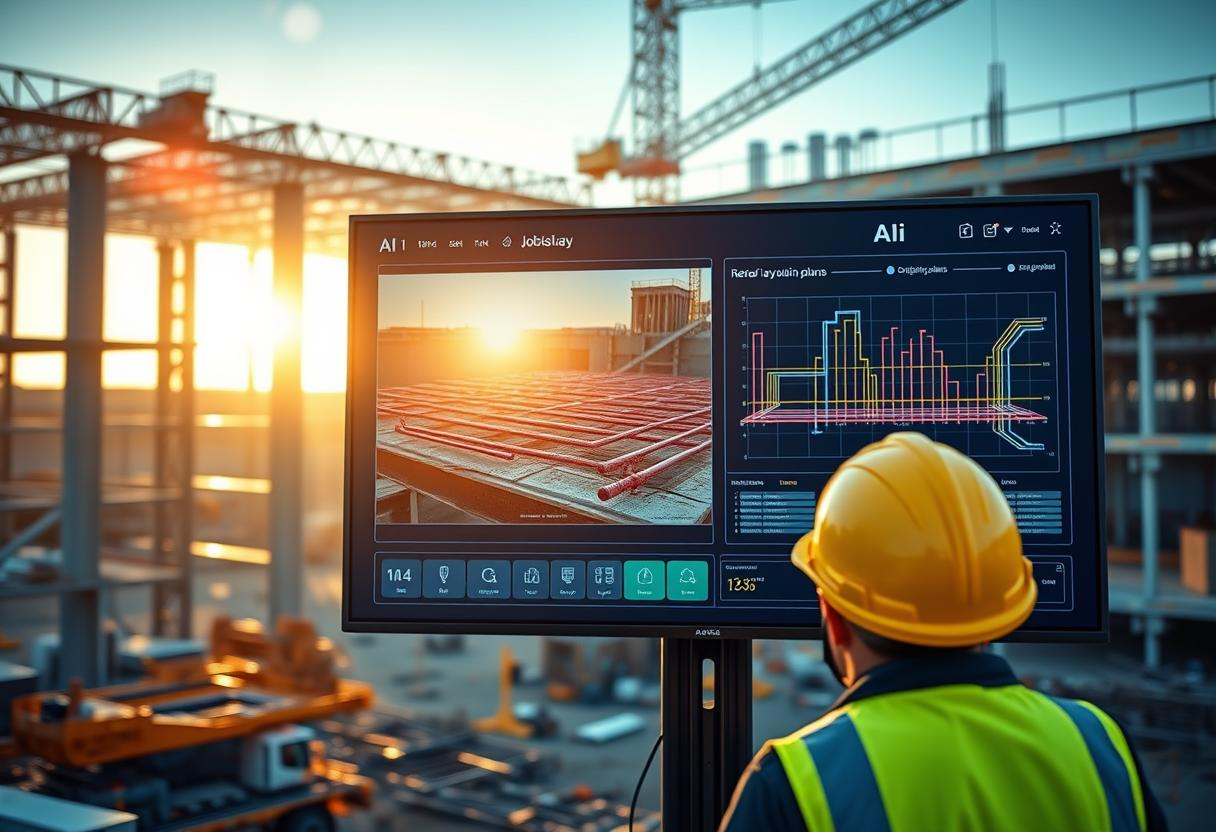
- Step 3: Access Instant Intelligence with AI-Powered Plan Reading. Get immediate answers directly from your project plans while in the field. Use an AI that can instantly read and extract critical information from drawings on your tablet. This includes automatically detecting the drawing's scale and allowing you to pull accurate measurements on the spot, turning your plan set into an interactive, intelligent tool.
- Step 4: Receive AI-Assisted Resource and Task Suggestions. Improve your daily planning with intelligent recommendations. As the system gathers data on your crew's performance, a future AI will be able to suggest optimal crew assignments for specific tasks based on historical productivity. It will also be able to proactively flag prerequisite tasks that are falling behind, helping you adjust your look-ahead schedule to prevent bottlenecks.
- Step 5: Enhance Safety with AI-Based Hazard Recognition. Turn your mobile device into a proactive safety tool. The next evolution of field AI will involve analyzing photos and videos for potential safety hazards. By uploading a photo of a work area, the AI could be trained to identify common OSHA violations, such as a lack of proper personal protective equipment (PPE) or unsecured materials, allowing you to correct issues before they lead to an incident.
AI Framework for Safety Directors
Goal: Achieve 100% compliance, create an unbreachable digital audit trail, and use data to predict and prevent incidents.
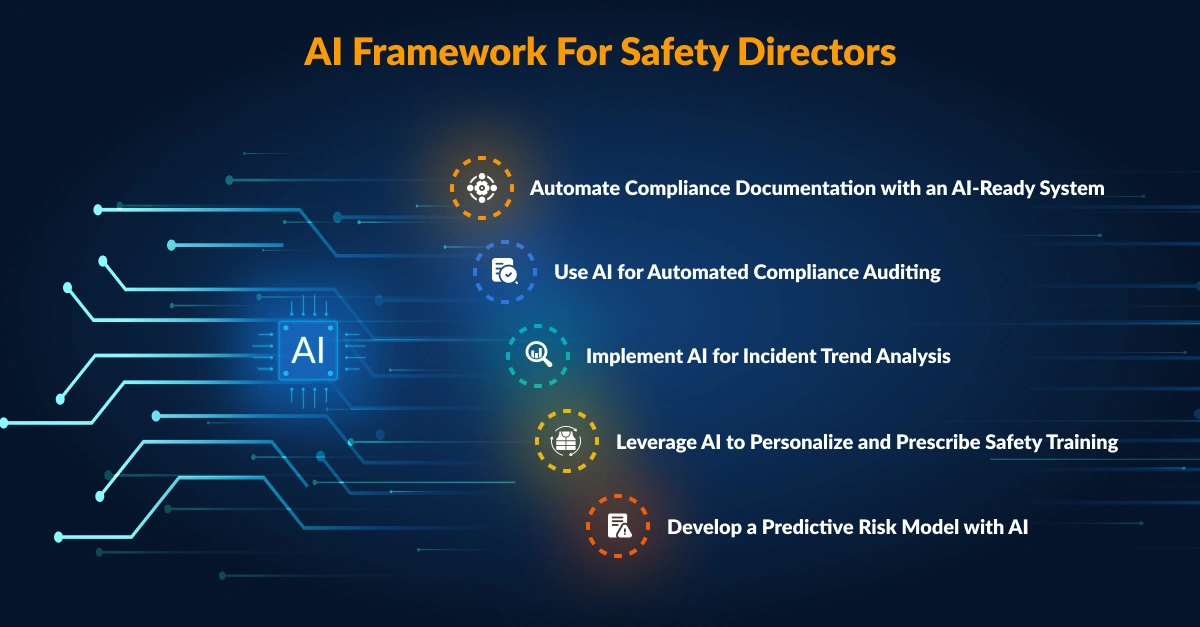
- Step 1: Automate Compliance Documentation with an AI-Ready System. Establish a foundation of perfect record-keeping. When you conduct a digital Toolbox Talk, the system automatically generates a timestamped PDF attendance record complete with digital signatures captured via QR code. This automated process creates the clean, structured data that an AI needs to perform more advanced analysis later.
- Step 2: Use AI for Automated Compliance Auditing. Ensure no detail is missed across all project documentation. A future AI application will be able to scan all project records, including daily logs, checklists, and incident reports, to audit for the presence of required safety documentation. The AI can flag days where a required pre-task safety plan was not attached or where a necessary inspection was not signed off, ensuring a complete and compliant safety file.
- Step 3: Implement AI for Incident Trend Analysis. Move from reacting to incidents to understanding their root causes. By feeding all digital incident reports into an analytical engine, an AI can identify non-obvious patterns and trends across all your projects. It may discover a specific type of incident occurs most frequently on Tuesday mornings or is more common with crews working on a particular kind of task, providing the insights needed to develop targeted prevention strategies.
- Step 4: Leverage AI to Personalize and Prescribe Safety Training. Deliver the right training to the right people at the right time. By correlating incident data with Toolbox Talk attendance, an AI will be able to identify crews or subcontractors with higher incident rates and automatically recommend specific safety training modules or Toolbox Talk topics to address their specific risk areas.
- Step 5: Develop a Predictive Risk Model with AI. The ultimate goal is to prevent incidents before they happen. By analyzing a vast dataset of daily logs, weather conditions, schedule pressures, and incident histories, a mature AI system can develop a predictive risk model. It could generate a daily "Site Risk Score," alerting you when a combination of factors, such as a new crew, forecasted high winds, and a critical schedule deadline, creates a high-risk environment, allowing you to deploy additional safety resources proactively.
The path to leveraging AI in construction operations begins not with a single, revolutionary tool, but with a commitment to foundational best practices in data management. By first digitizing and structuring critical workflows, such as T&M and OAC reporting, firms create the high-integrity data that intelligent systems require.
This framework empowers GCs and Trade Contractors to move beyond reactive problem-solving and adopt a proactive, data-driven approach to project delivery. The firms that implement these practices today are not just optimizing their current operations; they are building the framework to become tomorrow's industry leaders.

.webp)


.svg)

